
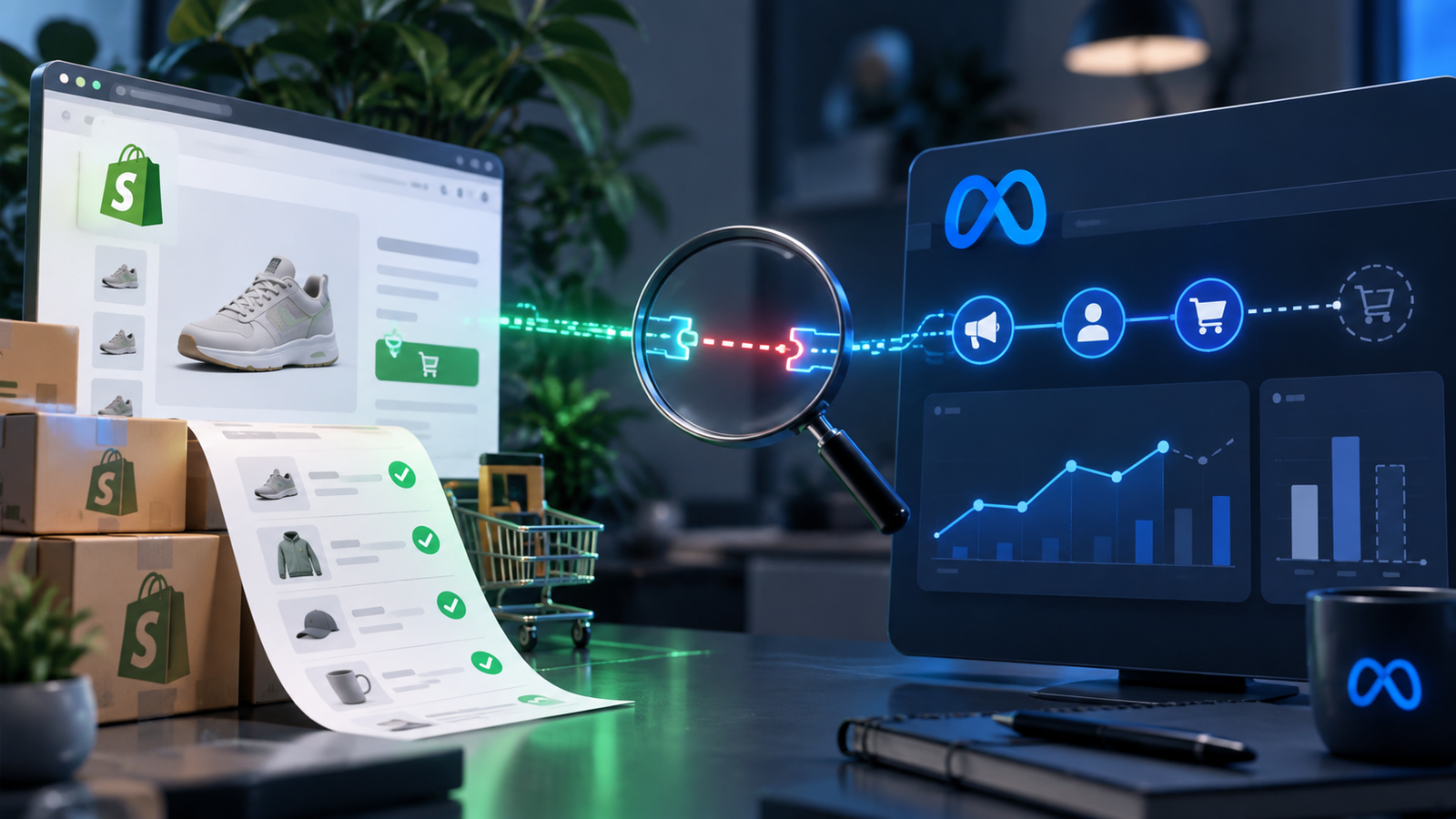
Shopify gives ecommerce brands a convenient way to manage products, orders, customers, and sales. But understanding exactly which marketing interactions contributed to those orders can become more complicated as a business adds advertising channels.
A shopper may discover a product through an advertisement, leave the website, return several days later, and complete a purchase. If the measurement system loses the connection between those interactions, marketers can end up making budget decisions based on incomplete information.
For growing Shopify brands, improving attribution is therefore less about collecting more numbers and more about maintaining the connection between marketing activity and actual store orders.
Why the Customer Journey Doesn’t Always Fit a 30-Minute Session
Online shoppers rarely follow a perfectly linear path to purchase.
Someone might click a Meta advertisement while browsing on their phone, compare products, leave the site, and return later after searching the brand name. Another customer might click an email and purchase the following day.
Read More: Maintaining a Clean Yard: A Comprehensive Guide to Professional Waste Removal
Shopify’s standard session-based reporting can make these journeys difficult to follow when the original session has ended. AdBeacon’s Shopify integration states that Shopify sessions last 30 minutes, meaning a later visit can potentially be classified as Direct when the original source is no longer associated with the session.
For marketers, that can create a gap between what actually influenced a purchase and what the store’s reporting appears to show.
Start With the Order Record
A useful way to approach attribution is to begin with the transaction rather than the advertising platform.
The order is the commercial event that matters: a customer purchased a product and generated revenue for the business. Connecting that order back to the marketing click that preceded it gives marketers a more consistent foundation for evaluating campaign performance.
AdBeacon uses first-party Shopify order data and connects it with recorded advertising clicks. Its system can associate orders with campaign and ad-level information while incorporating details such as revenue, discounts, refunds, and new-versus-returning customer status.
This creates a different starting point from relying solely on browser sessions or individual advertising dashboards.
Keep Attribution Connected After the Initial Visit
The longer a customer takes to make a decision, the more important continuity becomes.
Consider a shopper researching an expensive product. They might click an advertisement on Monday, read reviews on Tuesday, revisit the website on Thursday, and buy on Friday.
If each interaction is measured only within a short session window, the final purchase may appear disconnected from the marketing activity that initially brought the shopper to the store.
AdBeacon’s attribution system supports lookback windows of up to 180 days and maintains a first-party record of the relevant click and order relationship.
For brands with longer consideration cycles, this can provide additional context when evaluating acquisition campaigns.
Compare Marketing Reports With Store Revenue
Another issue Shopify brands face is that advertising platforms have their own definitions of conversions and attributed revenue.
Meta, Google, TikTok, and other platforms may each report revenue from the same customer journey. Adding those figures together can therefore produce a total that exceeds the actual sales recorded by the store.
AdBeacon’s approach is to show platform-reported performance alongside first-party attribution, allowing marketers to compare what an advertising platform claims with what the store actually recorded.
That comparison can be particularly useful when deciding whether a campaign deserves additional budget.
Look at More Than the Final Sale
Shopify brands also need to understand whether campaigns are acquiring new customers or primarily bringing existing customers back. The distinction can affect how marketers evaluate customer acquisition costs and longer-term value.
Read More: UAE Golden Visa and Business Setup: What Entrepreneurs Should Know
AdBeacon provides new-versus-returning customer reporting by channel, campaign, and ad, along with 30-, 60-, and 90-day lifetime-value reporting.
Bring Product Performance Into the Equation
Campaign-level reporting can also hide important differences between products.
A Shopify brand may discover that one advertising campaign produces strong initial sales but primarily promotes low-margin products. Another campaign may generate fewer orders while attracting customers who purchase repeatedly.
Connecting marketing attribution with product and customer data gives the team a broader view of performance.
AdBeacon includes product journeys, allowing brands to examine which products bring customers into the store and what customers purchase next. Its reporting also incorporates orders, returns, discounts, and coupon codes.
That information can make campaign evaluation more closely aligned with actual ecommerce economics.
Turn Attribution Into an Optimization Process
Good attribution should ultimately lead to action.
Once marketers can identify which ads are associated with real orders, they can make more informed decisions about budget allocation, creative testing, and customer acquisition.
AdBeacon combines attribution reporting with optimization features such as campaign and ad-level performance analysis, budget adjustments, creative reporting, and AI-powered recommendations.
The goal isn’t to eliminate every uncertainty in marketing measurement. No attribution model can perfectly reproduce every factor influencing a purchase. Instead, the objective is to establish a consistent measurement framework that starts with the brand’s own commercial data.
For Shopify businesses looking to strengthen that connection, AdBeacon’s attribution software for Shopify brands provides a first-party, click-based approach that links store orders with advertising activity and gives marketers a broader view of customer journeys, campaign performance, and revenue.
As ecommerce journeys become less predictable, having a reliable connection between marketing clicks and actual orders can make the difference between simply reporting performance and using that performance data to make better decisions.